
Assistant Professor
Karthikeyan Hariharan
Email: karthik[dot]hariharan[at]iitb[dot]ac[]dot[in
Phone: 8220423350
Education:
- PhD - Materials Science and Engineeing, The Ohio State University, USA, 2023
- B.Tech. - Metallurgical and Materials Engineering, NIT Tiruchirappalli, 2020
In his teaching, Prof. Karthik tries to appeal to the intuition through real-life examples
Courses he teaches include the following:
Undergraduate: Thermodynamics of Materials, Corrosion and Electrochemistry Lab
Postgraduate: Topics in Corrosion Research
Prof. Karthikeyan’s research spans all aspects of environmental degradation of structural alloys, including aqueous corrosion, high temperature corrosion, and coupled environmental-mechanical degradation. His work bridges physical metallurgy and electrochemistry. While his work is primarily experimental, he loves to leverage CALPHAD-based models in his work. He also has special interest in connecting processing-microstrucure with corrosion properties, and done considerable work into environmental degradation of additively manufactured Fe and Ni-based alloys. He maintains active contact with Oil & Gas, pipeline companies and is involved in industry-related projects with them. His group has active academic collaborations across the world, including Tohoku University (Japan), The Ohio State University (USA), University of Manchester (UK).
- Corrosion (Aqueous and High Temperature)
- Environmentally assisted cracking
- High Temperature Alloys
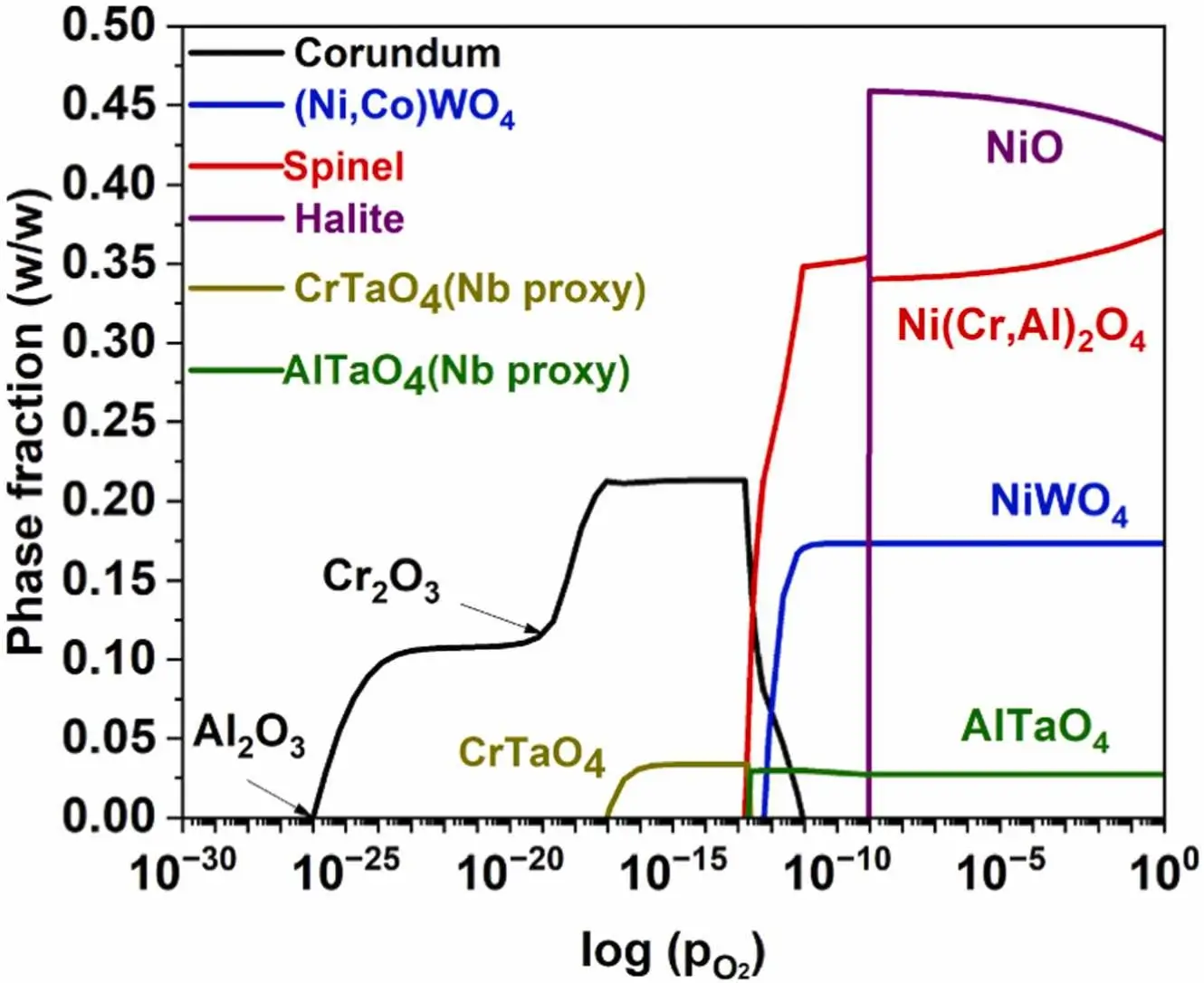
Emergency condition diagram based TCOX 13 database of ThermoCalc elucidating oxide stabilities and potential stratification in Ni-based superalloy 247[1]
- Hariharan, Karthikeyan, et al. "High temperature oxidation of Ni-based superalloy 247 produced by electron beam powder bed fusion additive manufacturing." Corrosion Science (2025): 113301.
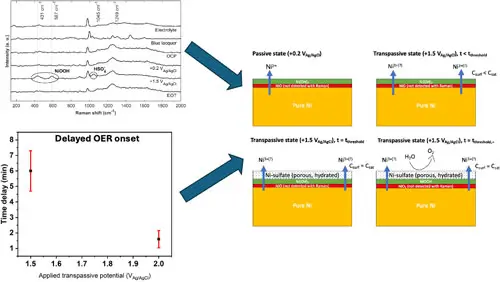
Mechanism of secondary passive film in Ni beneath a salt-film in transpassive regime revealed with in situ respirometry and in situ Raman spectroscopy[2]
2. Hariharan, Karthikeyan, et al. "On the Proposed Mechanism of Transpassive Film Formation in Pure Ni in Sulfate Environment: Insights from In Situ Raman Spectroscopy and Respirometry." Journal of The Electrochemical Society 173.3 (2026): 031501.
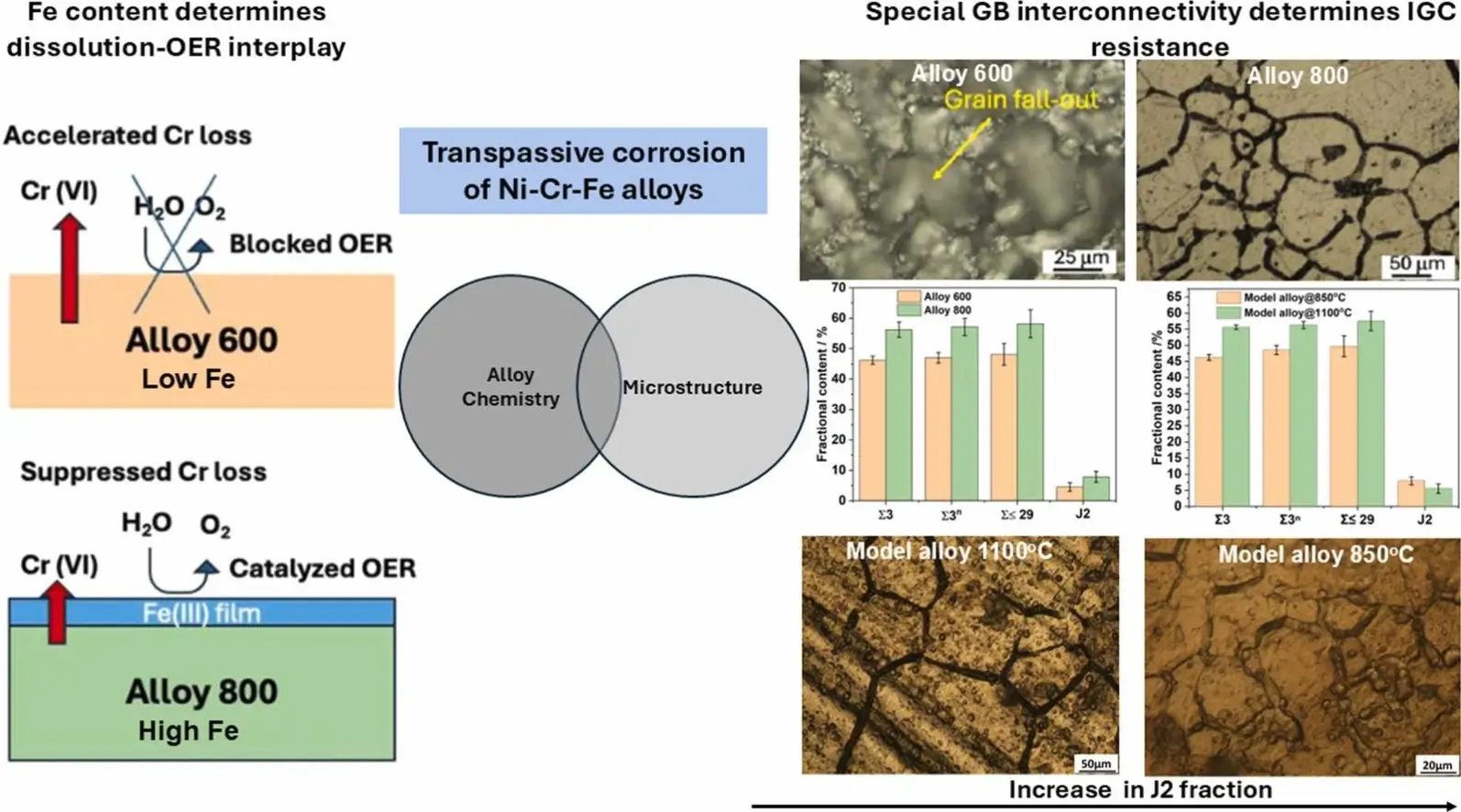
Alloy chemistry and microstructural features influencing dissolution-OER interplay and transpassive IGC behavior [3]
3. Hariharan, Karthikeyan, et al. "Metallurgical factors governing water oxidation-transpassive dissolution interplay and transpassive intergranular corrosion susceptibility of non-sensitized Ni-Fe-Cr alloys." Corrosion Science (2026): 113950.