
Associate Professor
Prasanna T. R. S.
Email: prasanna[at]iitb[dot]ac[dot]in
Phone: (+91) (022) 2576 7639
Education:
- PhD Materials Science, MIT, 1991
- B.Tech Metallurgical Engineering, IIT Madras, 1985
Some of the courses taught are: Undergraduate courses Experimental techniques in Materials Science, Structure of Materials, Electronic properties of Materials Postgraduate courses Thermodynamics of Materials, Xray Diffraction and Electron Microscopy
Currently, the ab initio total energy consists of the density functional theory (DFT) total energy and additional contributions from van der Waals dispersion and zeropoint vibrational energy. We have introduced a new contribution to the total energy, from electronphonon interaction. Due to its greater sensitivity to crystal structure (than vdW and ZPVE), by including EPI, we have resolved decadesold controversies on the stable structure of important materials e.g., hexagonal silicon carbide, SiC4H, (not cubic SiC3C) and cubic boron nitride, cBN, (not hexagonal hBN) are stable. We have derived the EPI contributions to the electronic and phonon free energies, relying on P.B. Allen’s general formalism for interacting quasiparticles, to go beyond the standard QuasiHarmonic Approximation, which is valid only for noninteracting quasiparticles. Our and Allen’s contributions, taken together, lay the foundation to go beyond QHA and include EPI contributions on all thermodynamic properties e.g., structural properties, and to determine, more accurately, the phase transition temperatures, pressures and phase boundaries, for all materials. We have proposed the equilibrium combination of doped Lanthanum gallate electrolyte and lanthanumdoped Ceria buffer layer for intermediate temperature solid oxide fuel cells so that, with time, additional phases that can reduce the fuel cell efficiency are not formed.
- Computational Materials Science
- Ab Initio total energy studies
- Electronphonon interactions
- Solid Oxide Fuel Cells
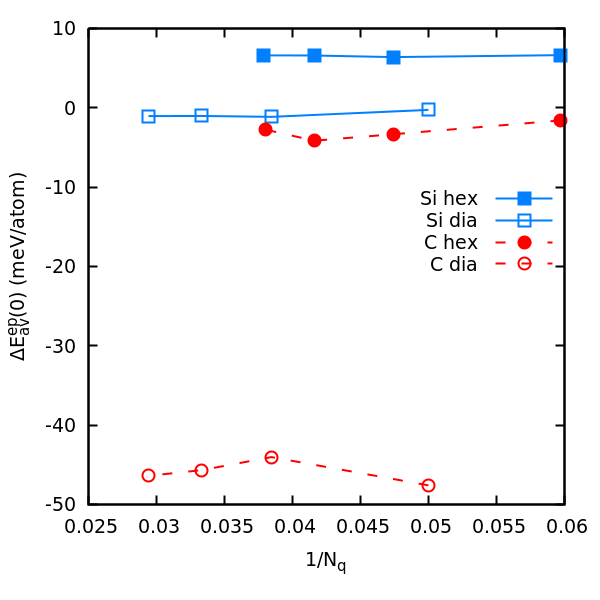
EPI contribution to the total energy vs phonon grid density for carbon and silicon polytypes
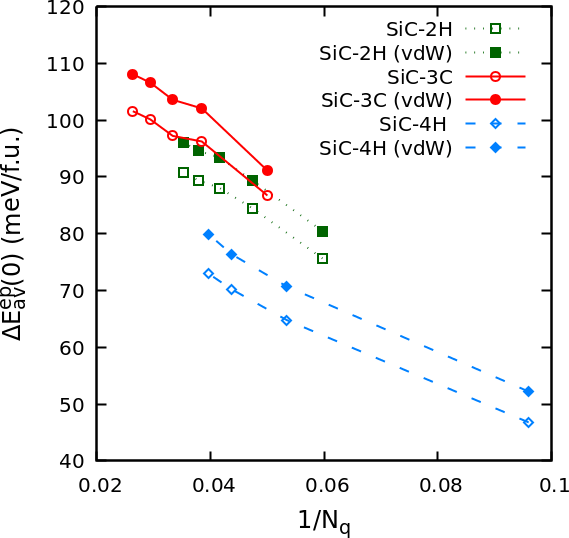
EPI contribution to the total energy vs phonon grid density for silicon carbide polytypes
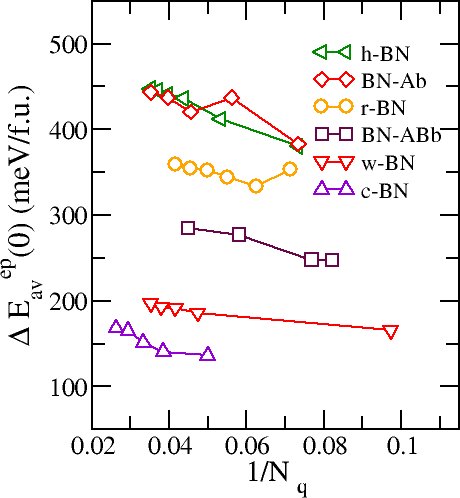
EPI contribution to the total energy vs phonon grid density for boron nitride polytypes
- A.V.R. Varma, S. Paul, A. Itale, P. Pable, R. Tibrewala, S. Dodal, H. Yerunkar, S. Bhaumik, V. Shah, M.P. Gururajan, and T.R.S. Prasanna. Electron−Phonon Interaction contribution to the total energy of Group IV semiconductor polymorphs. ACS Omega 8, 11251 (2023).
- S. Paul, M.P. Gururajan, A. Bhattacharya, and T.R.S. Prasanna. Critical role of electronphonon interactions in determining the relative stability of Boron Nitride polymorphs. (under review) https://arxiv.org/abs/2212.13877 (2022).
- S. Kumar, A. Chakraborty, S. Kobi, P. Gopalan and T.R.S. Prasanna. Phase formation between La(Sr)Ga(Mg)O3 and Ce(La)O2 for solid oxide fuel cell applications. J Am Ceram Soc., 105:3625–3635 (2022)