
Assistant Professor
Durga A
Email: a[dot]durga[at]iitb[dot]ac[dot]in
Phone: (+91) (022) 2576 5606
Education:
- PhD Matls. Engg., KU Leuven, Belgium, 2015
- BTech Met. & Matls. Engg., IIT Madras, 2009
Prof. Durga uses a variety of teaching methods including in-class short questions, group activities and project based assessment. There is a strong emphasis on process-structure-property correlations and modelling approaches in all her courses. She has taught the following courses:
Undergraduate Courses: Casting and Joining, Thermodynamics of Materials
Postgraduate Course: Additive Manufacturing with Metals
Prof. Durga's key research interest lies in modelling microstructure evolution when an alloy is subjected to different processes, be it casting, additive manufacturing (AM), or heat treatment. She has worked extensively on different approaches such as phasefield modelling, cellular automata and other numerical and analytical models. Through coupling such models with multicomponent Calphad thermodynamic and mobility databases, she has ensured that the models can be applied to technical alloys. In her research career thus far, she has worked on different projects collaborating with both industry and academia. Her research group is currently working on microstructure modelling during fusionbased metal AM [1,2] and solidstate phase transformations during AM. She is the PI of a project funded by the Science and Engineering Research Board on modelling microsegregation during metal AM and a co PI on a project within the JSW Technology Hub for Steel Manufacturing on alloy design.
- Computational Thermodynamics
- Metal Additive Manufacturing Phase
- Transformations Microstructure
- Evolution Mesoscale Modelling
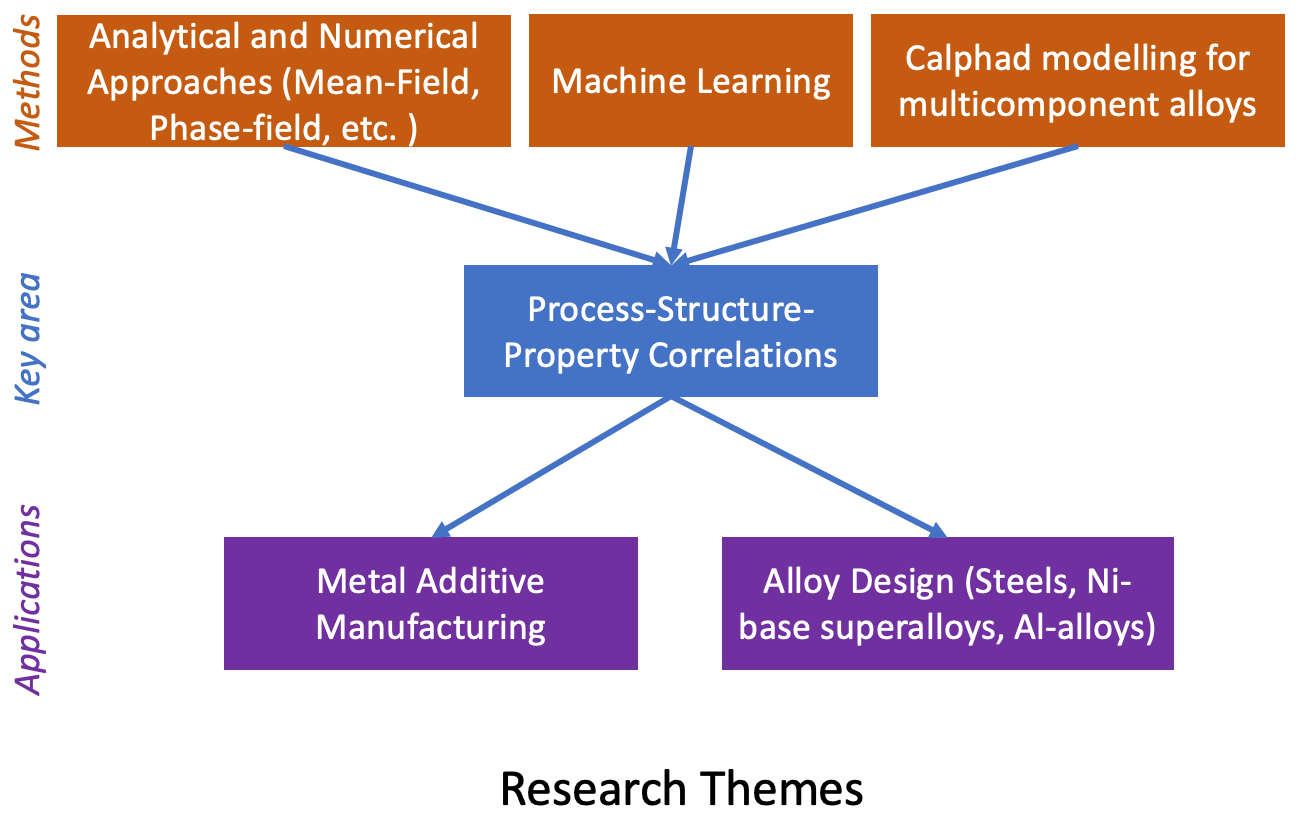
The key research themes of Prof. A. Durga's group
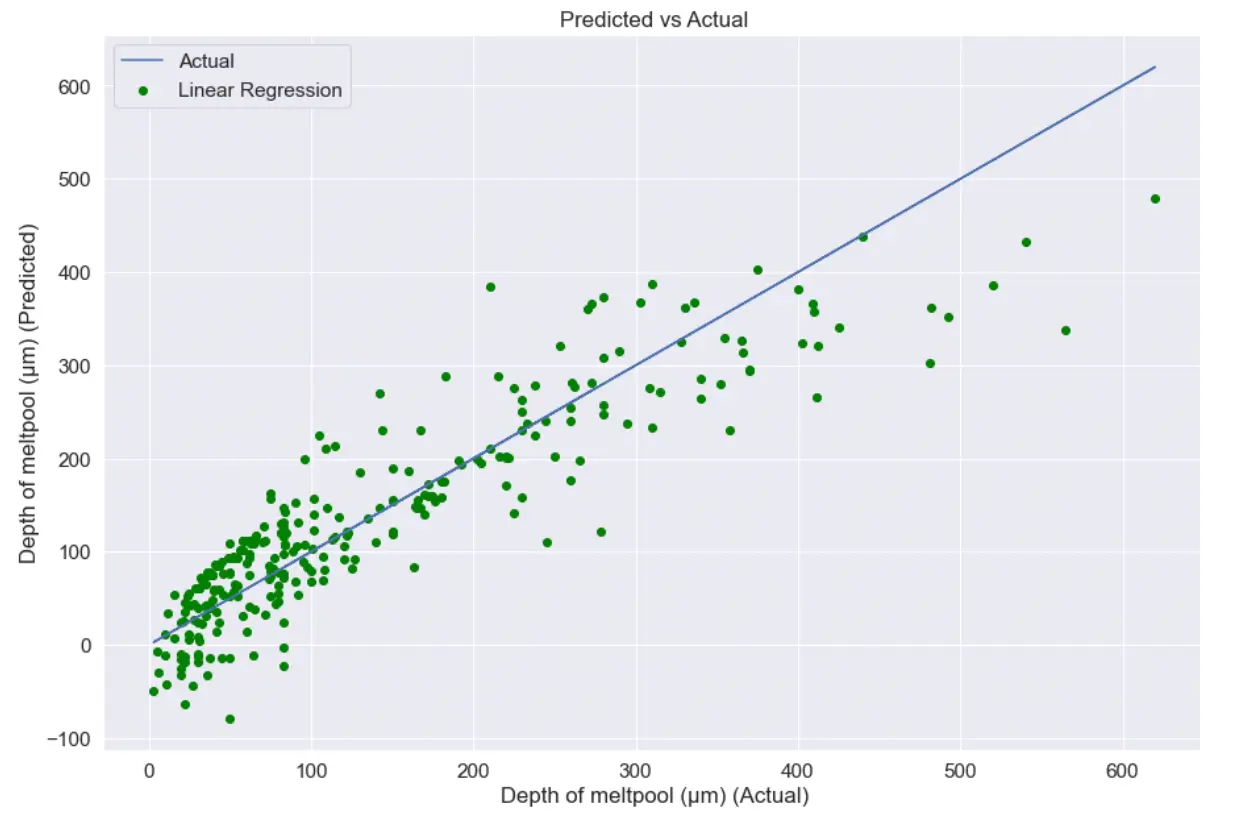
Comparison between the actual melt pool depths and those predicted using a linear regression model of additively manufactured Ti6Al4V alloy [1]
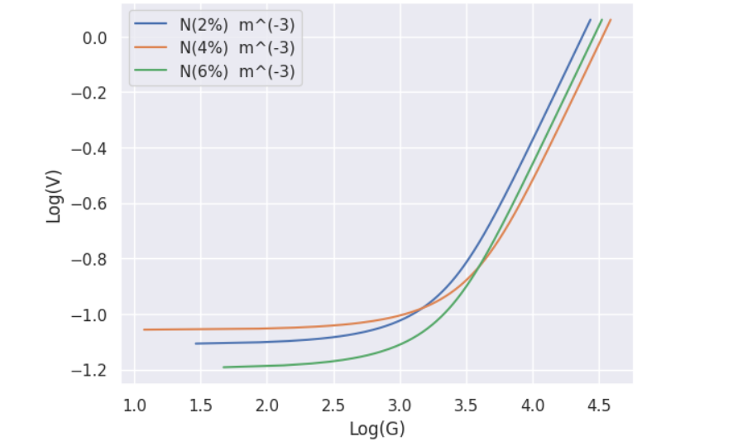
Temperature gradient G versus solidification growth front velocity V representing Columnar- toEquiaxed Transition in grain structure [2]
- Nitesh Kumar Sachan, Optimizing parameters for 3D printing of defect free parts using ML algorithms, M.Tech. Thesis, IIT Bombay, 2023.
- Loveneesh Lawaniya, Effect of heterogeneous nucleating sites on the asbuilt grain structure of additively manufactured steels, B.Tech. Project I, IIT Bombay, 2023.